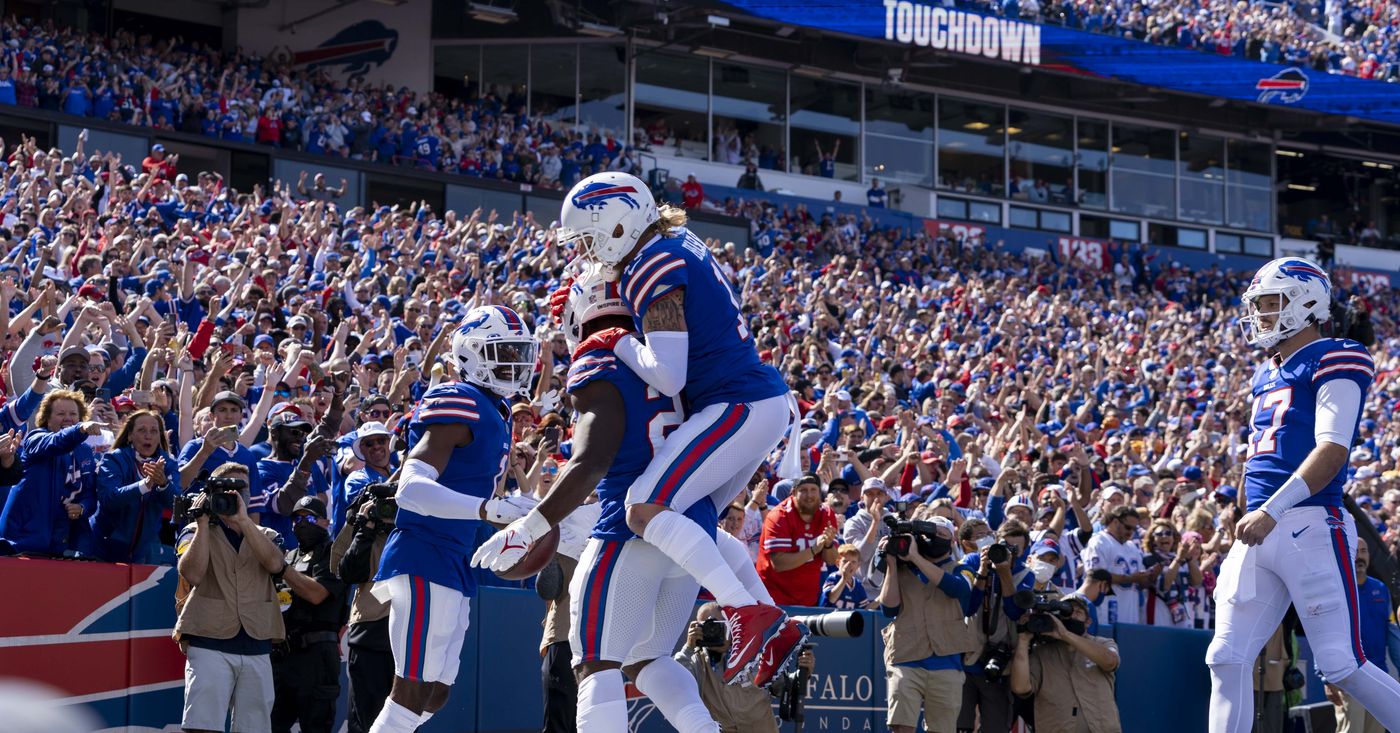
There's a pep rally for the 1-in-900 shot at the NFL. There's no pep rally for the $80,000 degree.
Schools have celebrated the star athlete over the top student since at least 1961, and pro sports is the one elite pipeline whose stars are mostly Black. Betting on varsity is a response to real incentives. The catch: the NFL drafts about 1 in 900 high school players.
· updated ·
The jackpot, when it hits. About 11 in 10,000 high school football players are ever drafted; fewer still get a moment like this. Photo: All-Pro Reels, Wikimedia Commons, CC BY-SA 2.0
Start with what a 15-year-old actually sees. In a landmark 1961 survey of American high schools (Coleman's The Adolescent Society), more boys in every school studied wanted to be remembered as a star athlete than as a brilliant student, and later studies of adolescent status still find sports a leading route to prestige for boys, though how dominant it is varies school to school. Varsity status pays immediately: recognition, identity, adults who advocate for you. Nobody holds a pep rally for a 5 on an AP exam.
And the visible end of the athletic pipeline is the one elite institution whose stars overwhelmingly look like Black boys. Black players are 70% of the NBA and 54% of the NFL, against 15% of public school students. On the academic track, the adults who push a kid forward are scarcer: this site measured Texas schools placing Black students in advanced courses about 6 points below what their own test scores predict.
Black share of each stage, per 100
NBA players (2022-23) 70.4%
NFL players (2023) 53.5%
D1 basketball players (2021-22) 52.4%
D1 football players (2021-22) 44.7%
US public school students (2022) 15.0%
TIDES racial report cards (NFL 2023, NBA 2022-23, Division I 2021-22) and NCES enrollment (fall 2022). The recognition pipeline is the mirror image of the classroom pipeline.
1 in 900High school football players eventually draftedChaining NCAA's own rates: 8.1% reach the NCAA, 1.4% of draft-eligible players are drafted (257 picks in 2025). Drafted is not employed; making a roster is rarer still.
1 in 2,800High school basketball players eventually drafted3.6% reach the NCAA, and 1.0% of draft-eligible NCAA players are drafted; 43 of the 2024 draft's 58 slots went to NCAA players. The most Black-identified pipeline has the longest odds.
$80K vs $47KThe degree, for comparisonMedian earnings, bachelor's versus high school only, a return the NY Fed puts near 12-13% a year for three decades. Set that against a bet that pays off 0.1% of the time.
Two numbers people repeat about all this turned out wrong, and both are too grim. "Only about 3 percent of high school football players play in college" matches an old Division I-only figure; across all NCAA divisions the real rate is 8.1 percent, nearly three times the folklore. "Two in ten thousand make the NFL" is also too dark: NCAA's own chained rates put drafted alone near eleven in ten thousand, about five times the folklore. The jackpot is still tiny. But the folklore paints the path as an even longer shot than it is, and the honest numbers are worth having.
A boy choosing varsity is not deluded; he is reading his environment correctly. One track pays at 16, in recognition and adult backing. The other pays at 30, conditionally, and, as the advanced-course finding on this site shows, with thinner backing even when he outscores his classmates. The fix this data points at is the same one as always: make the academic track pay visibly and automatically, the way universal screening and opt-out honors placement did where they were tried.
How does your school compare?
Every Texas campus, every student group, 2012–2025.